POSITIONED™ by High Class Hustle
You May Not Need More Visibility. You May Need a Stronger Position.
When people can see your work but still cannot understand where your value fits, doing more may not be the answer. A clearer position may be.

Can we talk about what happens when your work is visible - but your value still feels hard to place?
You have shown up. You have learned the work, helped people, collected experience, and kept moving even when the path was not simple. Your name may be in the room. Your posts may be reaching people. Your résumé may be solid. Your ideas may be good.
And still, the opportunity does not move.
That can make you wonder whether you need to post more, network harder, rewrite your bio again, launch another offer, or explain every part of your experience in one conversation.
But sometimes people have already seen you.
They just do not fully understand what to trust you with, where your work fits, or what should happen next.
This distinction matters because more attention cannot repair a gap you have not identified. It can make the gap louder. It can send more people toward a message, profile, offer, or professional presence that still leaves them unsure.
That does not mean you are unqualified. It does not mean your work lacks value. It may mean your position needs a clearer structure.
The Pressure to Become More Visible
Professional advice often treats visibility like the answer to everything. Be consistent. Build your brand. Post daily. Attend more events. Speak up. Start a newsletter. Create a new offer. Get on another platform.
Some of that can help. People cannot consider work they never encounter.
But visibility is only one part of the decision. Once someone sees you, several quieter questions begin:
- Is this person prepared for what they are asking for?
- Can I see evidence that supports the claim?
- Do their professional signals build trust?
- Can I quickly understand the value?
- Can they sustain the work if the opportunity arrives?
If those questions remain unanswered, more impressions may not create more movement. You may receive attention without understanding, praise without placement, or interest without a clear decision.
That is why professional positioning deserves its own conversation.
Visibility Is Not The Same As Being Understood
Being visible means someone has encountered you. Being understood means they can make sense of what they encountered.
Someone may know your name and still be unable to explain what you do. They may admire your experience and still not know which problem to bring you. They may trust your character and still not understand the next step.
This is especially common when your experience crosses more than one area. You may be a business owner, educator, community builder, service professional, author, organizer, or strategist. Those experiences can strengthen one another, but only when the connection is clear.
Without that connection, your experience can look scattered even when it is deeply related.
Professional positioning is the way your preparation, proof, presence, clarity, and capacity work together so people can understand your value and know where it fits.
It is not about forcing yourself into one narrow label. It is about helping people recognize the throughline.
My own work has moved through beauty, education, business ownership, community service, leadership development, and practical resource building. The strongest professional story is not a list of unrelated titles. It is the consistent role beneath them: helping people and communities move forward with more preparation, presence, and access to useful next steps.
That kind of clarity does not erase range. It gives range a home.
More Attention Can Magnify an Unclear Message
Imagine increasing traffic to a page that does not clearly explain who it serves. More people arrive, but more people also leave unsure.
Imagine entering more rooms with an introduction that changes every time. You meet more people, but the pattern remains difficult to remember.
Imagine adding another offer when the existing offers do not have a clear relationship. The catalog grows, but the decision becomes heavier.
This is not a reason to hide. It is a reason to pause long enough to ask a better question:
That question protects your energy. It moves you away from endless activity and toward a more useful review of what is already present.
Sometimes the answer is not a complete rebrand. It may be one missing proof point, one unclear sentence, one outdated page, one unsupported promise, one capacity issue, or one next step that is too difficult to find.
Small gaps can create large confusion. Clearer positioning helps you notice which gap deserves attention first.
What Professional Positioning Actually Means
Professional positioning is not status. It is not pretending to be more important than you are. It is not a polished image covering an unstable foundation.
It is the practical relationship between what you are ready for, what you can demonstrate, what people experience, what they understand, and what you can carry.
This broader view of readiness aligns with established career-readiness work. The National Association of Colleges and Employers identifies communication, critical thinking, leadership, professionalism, teamwork, technology, career development, and related competencies as connected parts of readiness—not technical skill alone. You can review its career-readiness competencies.
POSITIONED™ organizes the professional positioning conversation around five connected areas called the Positioning Quotient™:
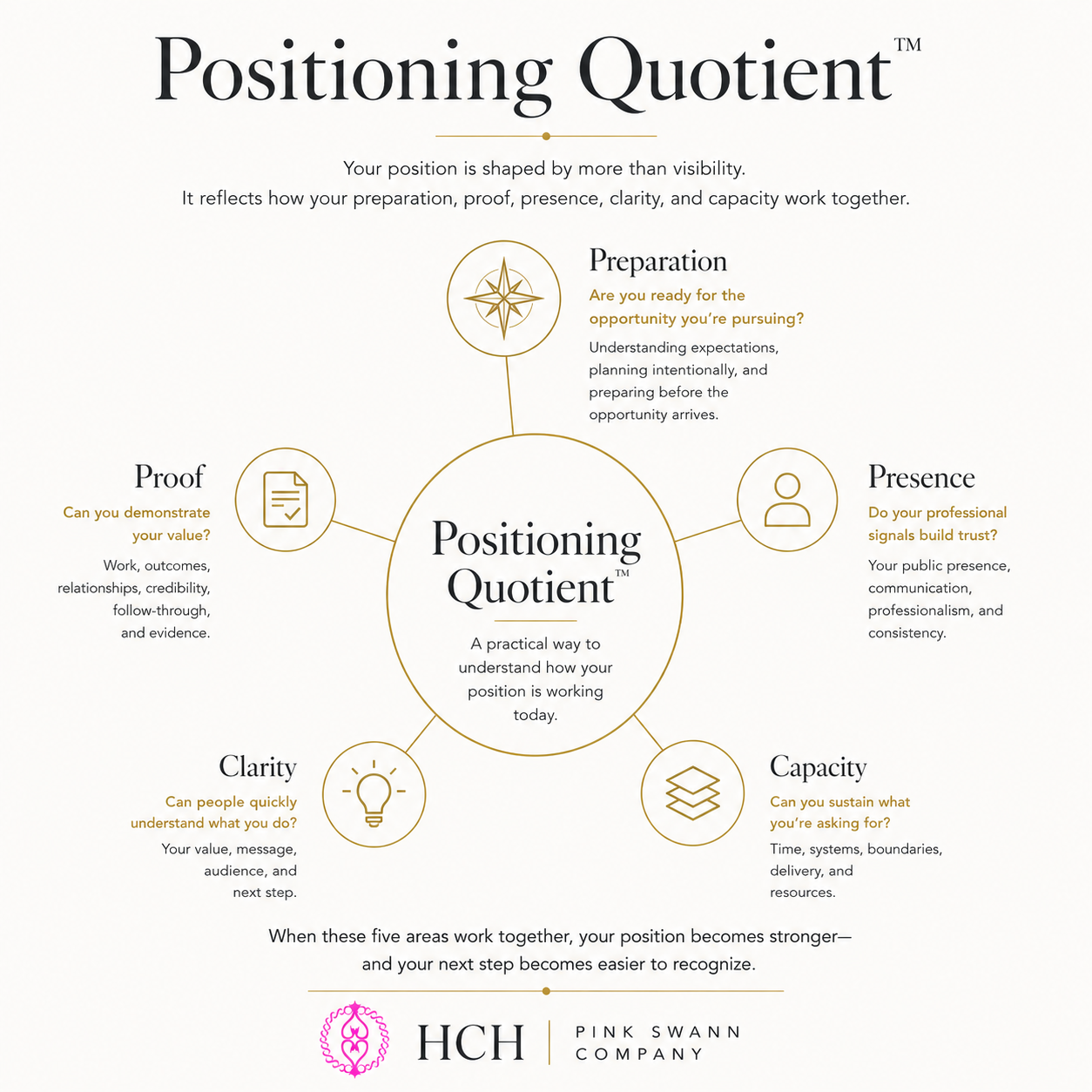
Five Areas That Shape Your Position
Preparation: Are you ready for the opportunity you are pursuing?
Preparation is more than having the required skill. It includes understanding the environment, the expectation, the decision, the timing, and the next move.
You can be talented and still enter an opportunity without enough context. You can have the right idea and still be unprepared to explain it. You can be invited into the room and still need a clearer understanding of what the room requires.
Preparation may include:
- researching the organization, audience, or decision-maker;
- understanding what success looks like in that setting;
- knowing which part of your experience is most relevant;
- preparing questions instead of trying to know everything;
- choosing the next step before the conversation ends.
Preparation is not perfection. It is reducing avoidable uncertainty so you can respond with intention.
Proof: Can you demonstrate your value?
Proof is the evidence that helps another person trust the story you are telling.
It includes outcomes, but it is not limited to dramatic numbers. Proof can also be documented learning, a completed project, a professional invitation, a trusted relationship, a certificate, a system you created, a testimonial, a sample, a follow-through pattern, or a clear record of contribution.
This matters because capable people often carry proof in scattered places:
- inside inboxes;
- across camera rolls;
- in meeting notes;
- inside old reports;
- within conversations other people remember, but the professional never documented.
When proof remains scattered, you may feel as if you have to explain your entire history every time. Organized proof allows the work to speak with you.
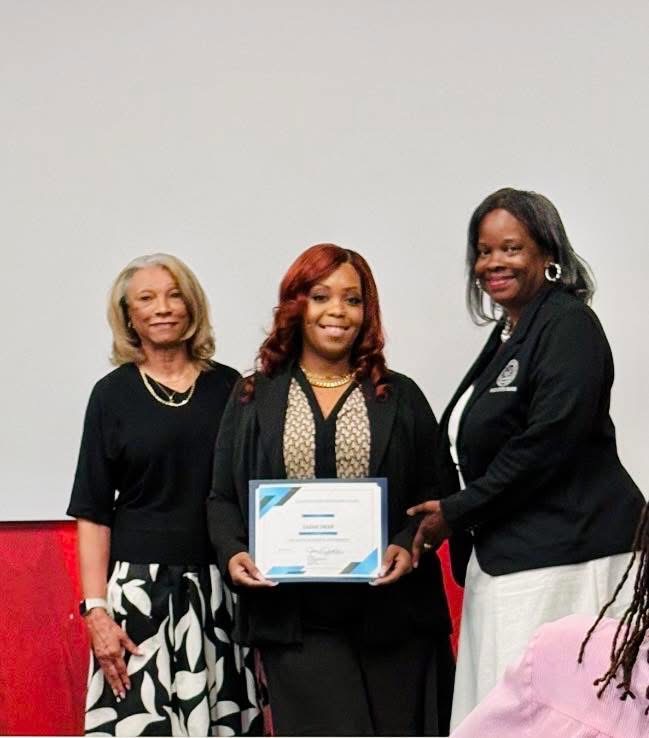
Receiving a leadership cohort certificate is one piece of proof. The deeper value is not the paper alone. It is the learning completed, the relationships built, the responsibility accepted, and the work that follows.
Quiet proof does not need spectacle. It needs context.
Presence: Do your professional signals build trust?
Presence is what people experience before you have time to explain.
It includes your website, email address, biography, introduction, visual presentation, communication rhythm, meeting behavior, consistency, and the way information is organized around you.
People form quick impressions from limited information, and those impressions can be influential without being complete. The American Psychological Association offers a useful discussion of how first impressions can be shaped by both real signals and bias.
That is why presence should not be treated like performance. The goal is not to manufacture perfection. The goal is to reduce unnecessary doubt.
A professional email address will not replace skill. A polished page will not replace proof. A strong introduction will not repair a capacity problem. But aligned signals make it easier for people to trust what they are seeing long enough to consider the substance.
For a practical starting point, the Professional Presence Starter Pack can help you review foundational signals without turning the process into a complete reinvention.
Clarity: Can people quickly understand what you do?
Clarity is not reducing your life to one sentence. It is choosing the right sentence for the moment.
A clear position helps people understand:
- what you do;
- who or what the work serves;
- which problem or meaningful moment you help address;
- why your experience is relevant;
- what action makes sense next.
Without clarity, people may compliment your work but fail to refer it. They may enjoy your content but not know which offer to choose. They may respect your experience but struggle to repeat your value in another room.
That last part matters. Strong professional positioning should travel when you are not present.
Someone should be able to say, “You need to talk to Sarah. She helps people and organizations become more prepared, more present, and clearer about the next step,” without needing a ten-minute explanation.
Clarity is not about making yourself smaller. It is about making your value easier to carry.
Capacity: Can you sustain what you are asking for?
Capacity is the area many professional-positioning conversations leave out.
You can prepare well, show strong proof, communicate clearly, and build trust—then struggle when the opportunity arrives because the systems, time, boundaries, energy, or resources are not ready to support it.
Capacity may include:
- time available for delivery;
- a clear scope and decision process;
- support, tools, and documentation;
- communication boundaries;
- financial and operational room;
- the emotional bandwidth to carry the responsibility.
Protecting capacity is not a lack of ambition. It is stewardship.
A stronger position does not only help you pursue more opportunities. It helps you pursue the opportunities you can support with dignity and consistency.
How To Tell When Visibility May Not Be The Real Problem
Visibility may not be the primary issue when:
- people regularly ask what you do after visiting your page;
- your introduction changes so much that no one version becomes memorable;
- you receive praise, but few clear referrals or next-step questions;
- your strongest proof is difficult to find or explain;
- your offers, titles, and experiences appear unrelated;
- people can see your activity but cannot identify the value behind it;
- you keep adding more content while avoiding a decision about the message;
- you are attracting interest you do not have the capacity to support;
- you feel pressure to overexplain because the foundation is not doing enough work for you.
None of these signs means you have failed. They are information.
They help you move from “I need to do more” toward “I need to understand what deserves attention.”
Five Questions To Ask Before You Do More
You do not need a full strategy session to begin noticing your position. Start with five honest questions.
1. Preparation: What opportunity am I actually preparing for—not generally, but specifically?
2. Proof: What evidence would help another person trust that I can carry it?
3. Presence: What do my current professional signals communicate before I explain?
4. Clarity: Could someone repeat my value accurately after one conversation?
5. Capacity: What would need to be true for me to support the opportunity well?
Notice which question creates the most hesitation. That hesitation may point toward the area that deserves attention first.
Do not rush to fix all five at once. A useful review creates direction, not a new reason to feel behind.
What Stronger Professional Positioning Can Change
Stronger positioning cannot guarantee that every person will choose you. It cannot control hiring decisions, client budgets, partnership timing, gatekeeping, bias, or whether an opportunity is genuinely aligned.
What it can do is improve the quality of the information around the decision.
A stronger position can make it easier to:
- recognize which opportunities fit;
- prepare for a conversation with more intention;
- choose the proof that matters in that setting;
- communicate value without telling your entire life story;
- build trust through consistent professional signals;
- protect capacity before saying yes;
- give other people language they can use when referring you.
That is meaningful progress. Not because it makes every outcome certain, but because it reduces avoidable confusion.
Start With a Focused First Look
When you have been carrying the question “Why am I being overlooked?” it is tempting to search for one dramatic answer.
Usually, the more useful answer is specific.
Your proof may be stronger than your language. Your presence may be polished while your capacity is stretched. Your preparation may be solid, but the next step may be difficult to find. You may have meaningful experience with no organized way to show how it connects.
The Position Snapshot™ was created to help you take that first look.
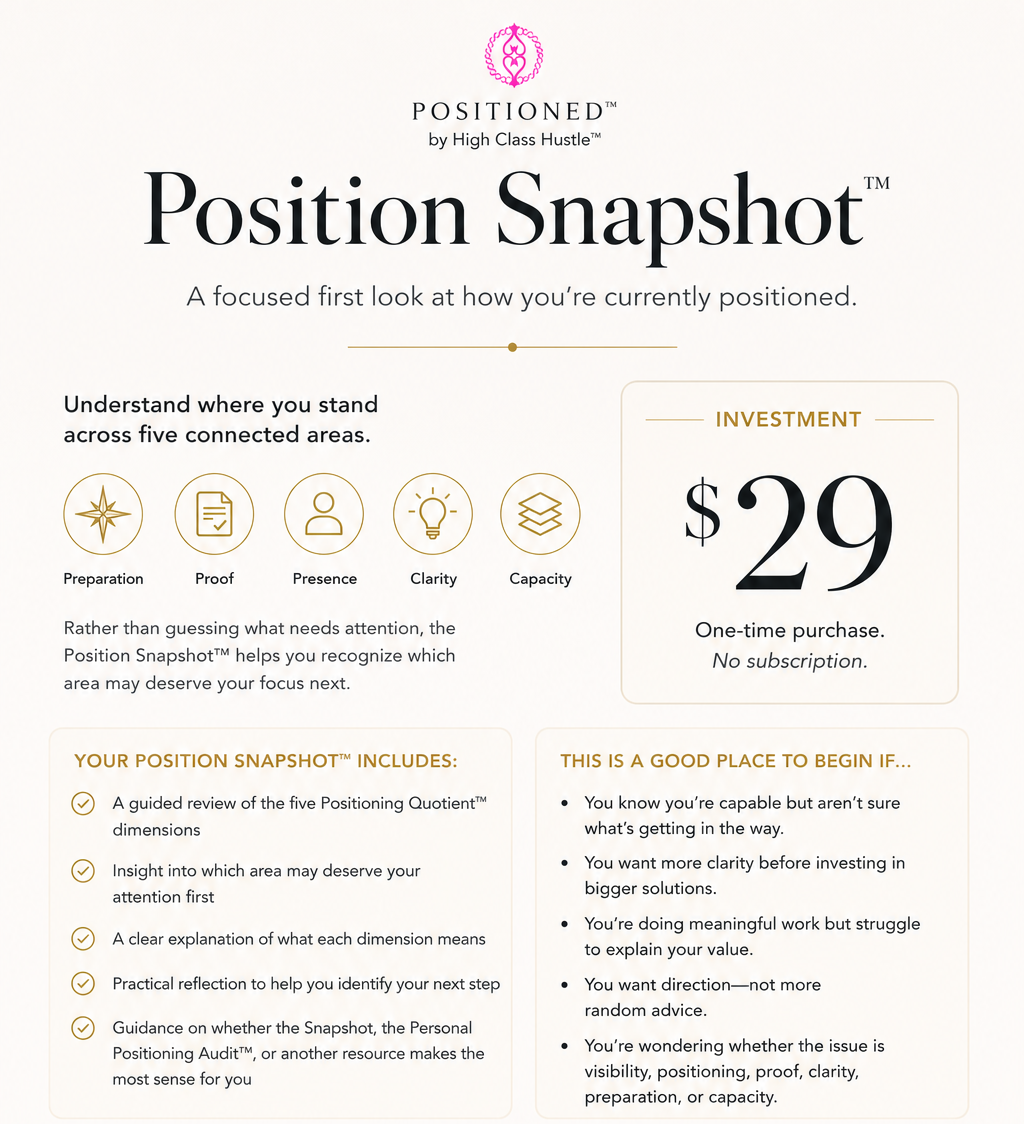
It is not a personality test, and it is not a measure of your worth. It is a practical review designed to help you notice which area may deserve attention before you add more activity.
The $29 experience includes a guided review of the five Positioning Quotient™ dimensions, a PQ Snapshot Scorecard™, clear explanations, and practical guidance for considering your next step.
Position Snapshot™ vs Personal Positioning Audit™
The right starting point depends on the depth of support you need.
| Feature | Position Snapshot™ | Personal Positioning Audit™ |
|---|---|---|
| Purpose | A focused first look | A deeper personalized analysis |
| Best for | Someone who wants to identify what may deserve attention first | Someone who wants a complete personalized review and action guidance |
| Core output | PQ Snapshot Scorecard™ and practical guidance | Complete Position Intelligence Package™ |
| Availability | Available now for $29 | Opens July 20, 2026 |
The Snapshot is a legitimate standalone starting point. You do not need to purchase the deeper Audit to receive value from it.
Frequently Asked Questions
What is professional positioning?
Professional positioning is the way your preparation, proof, presence, clarity, and capacity work together to help other people understand your value and know where it fits. It is broader than appearance or promotion because it includes readiness, evidence, communication, and the ability to support an opportunity.
Why am I being overlooked even though I am qualified?
Qualifications matter, but they may not be visible, easy to understand, relevant to the specific opportunity, or supported by a clear next step. You may also be affected by timing, access, bias, budget, competition, or factors outside your control. Being overlooked does not automatically mean you lack ability.
Is professional positioning the same as personal branding?
No. Personal branding often focuses on how you present yourself publicly. Professional positioning is broader. It includes how prepared you are, what evidence supports your work, what your professional signals communicate, how clearly people understand your value, and whether you can sustain the opportunity.
How is visibility different from positioning?
Visibility answers whether people can see you. Positioning answers whether they can understand, trust, and place your value. Visibility can introduce you. Positioning helps people decide what your work means in relation to a need or opportunity.
What are the five Positioning Quotient™ areas?
The five areas are Preparation, Proof, Presence, Clarity, and Capacity. They are reviewed together because strength in one area does not automatically repair a gap in another.
Is the Position Snapshot™ a personality test?
No. It does not assign a personality type, diagnose a condition, or measure personal worth. It is a practical review of five areas that influence professional position.
What is the difference between the Position Snapshot™ and the Personal Positioning Audit™?
The Position Snapshot™ is a focused first look with a PQ Snapshot Scorecard™ and practical guidance. The Personal Positioning Audit™ is the deeper personalized option and includes the complete Position Intelligence Package™.
Can stronger positioning guarantee a job, client, partnership, invitation, or sale?
No. Stronger positioning can improve understanding, preparedness, trust, and decision quality. It cannot control another person’s decision or guarantee a particular outcome.