
A new idea can feel like relief.
For a moment, it gives you somewhere fresh to put your energy.
There is a name to explore, a page to build, a program to outline, a logo to imagine, or a new service to announce. Starting over can feel productive because everything is still full of possibility.
The existing work is usually less exciting.
It asks you to look closely at what people keep requesting, what has already become useful, what is difficult to explain, and what the business can actually support.
That is where I found myself while simplifying Pink Swann.
I realized I was building things faster than I could responsibly support them.
At the same time, people kept asking me for websites.
But a website was not always the first thing they needed.
Some had a logo but no clear offer. Some had branding but no cohesive way to explain what they sold. Some were trying to turn every skill into a service at once. Others were preparing to spend money on a website before they could name the audience, result, price, or next step the website was supposed to support.
They did not always need another thing built.
They needed a way to sort what was already there.
The question is not only, “What should I sell?”
That is a useful question, but it is not complete.
A stronger set of questions is:
- What problem keeps returning?
- What do people already trust me to help with?
- What work are they already requesting?
- What useful result have I already created?
- What can I explain without inventing new language?
- What can I deliver consistently without weakening everything else?
Those questions move the decision away from trends and toward evidence.
They also keep branding in its proper place.
A name, logo, color palette, or website may help package an offer. They cannot replace the offer plan.
Before someone pays to make the work look more established, they should be able to explain:
- who the offer is for;
- what recognizable problem it addresses;
- what the person receives;
- what becomes easier or possible afterward;
- what the work costs;
- how it will be delivered;
- and what the buyer should do next.
Without those decisions, the website may become an expensive place to display unresolved thinking.
The opportunity you are looking for may already be asking for your attention.
Look at what keeps finding you
A viable business opportunity often leaves clues before it becomes an official offer.
The clues may not arrive as a polished request.
Someone may ask, “Can you help me figure out what should go on my website?”
The deeper need may be offer clarity.
Someone may ask for branding.
The deeper need may be a professional presence that makes their work easier to understand.
Someone may ask whether you “do consulting.”
The opportunity may be inside the decisions you already help people make informally.
This does not mean every question should become a product.
It means repeated questions deserve to be examined before another idea is invented.
Repetition is a signal, not automatic proof
A repeated question may show that a need exists.
It does not automatically prove that people will pay, that the delivery will be sustainable, or that you are the right person to solve it.
Treat repetition as an invitation to investigate.
Ask who is making the request, how often it appears, what they have already tried, how urgent the problem is, and what the unresolved problem is costing them in time, money, confidence, or movement.
Existing work may contain the first version of the offer
Look at the work you are already doing repeatedly.
You may be answering the same question in private messages, rebuilding the same document for different clients, reviewing the same type of page, correcting the same mistake, or guiding people through the same decision.
The offer may not require entirely new expertise.
It may require your existing expertise to become easier to understand, access, and deliver.
Trusted results matter more than trend alignment
A trend can introduce a useful opportunity.
It can also make unrelated work look urgent.
Before following it, ask whether the idea fits your audience, your capabilities, your values, and the business you are actually building.
The goal is not to become immune to new ideas.
The goal is to stop allowing every new idea to outrank the evidence already present.
Branding should make a real offer easier to recognize. It should not be asked to create substance the offer has not earned yet.
Three things make an opportunity more usable
An opportunity becomes more viable when a recognizable need, an explainable result, and a responsible delivery path meet.
A need people already recognize
The audience should be able to recognize the problem without learning specialist language first.
“People visit my site but still do not understand what I sell” is recognizable.
“My positioning architecture lacks narrative cohesion” may be technically accurate, but it asks the audience to translate before they can see themselves in the problem.
Start with the moment they already know:
- the inquiry that goes nowhere;
- the service that takes too long to explain;
- the proposal that has to be rewritten every time;
- the opportunity that arrives before the materials are ready;
- or the website request that exposes an unclear offer.
A result you can explain
A strong opportunity is not defined only by the work you perform.
It is defined by what the buyer can understand, decide, complete, maintain, or do more confidently afterward.
Instead of listing every feature, complete this sentence:
After this work, the person will be better able to ____________________.
If the answer remains broad, the offer probably needs more clarity before it needs more design.
A delivery path you can responsibly support
Interest does not automatically make an offer ready.
The work also needs a delivery path.
- Can the work be completed with care?
- Is the timeline realistic?
- Is the scope understandable?
- Does the price support the labor and required resources?
- Can the next step be completed without unnecessary confusion?
- Can the business maintain the experience after interest increases?
Capacity is not the enemy of opportunity.
Capacity helps determine whether the opportunity can become trustworthy.
Do not build the whole thing before the idea earns it
This is where many capable people create unnecessary work.
A question appears.
They name the product, buy a domain, commission a logo, create a full curriculum, build a sales page, and arrange a launch before confirming whether the problem, buyer, result, and delivery model are clear.
A better approach gives the opportunity a chance to prove itself in stages.
The Opportunity Sequence
Use this sequence before giving a new idea more money, time, or infrastructure than it has earned.
Notice
Capture the questions, requests, repeated tasks, and useful outcomes already appearing.
Organize
Group similar requests so one loud conversation does not receive the same weight as a recurring pattern.
Clarify
Name the buyer, problem, result, scope, and next step in language the audience already understands.
Test
Use a conversation, small paid engagement, diagnostic, pilot, or simple invitation before building a complete offer environment.
Deliver
Complete the work carefully enough to learn what the promise actually requires.
Document
Record the questions, decisions, outcome, client-safe proof, and improvements before the lesson disappears into memory.
Expand
Add infrastructure, visibility, and scale only after the earlier stages provide evidence that the opportunity deserves them.
Why I created the Money Moves Map
I created the Money Moves Map because I was tired of watching capable people scramble all over the place and reinvent the wheel.
They were spending time on logos, websites, branding, names, and disconnected services without a cohesive offer plan beneath them.
The problem was not a lack of talent.
It was that every idea was competing at the same volume.
Nothing had a clear place.
The Map creates one place to look at:
- the opportunities already present;
- the people asking for help;
- the need beneath the request;
- the evidence you already have;
- the work you can responsibly deliver;
- and the next test that deserves attention.
It does not choose the business for you.
It helps you stop treating every possible move as equally urgent.
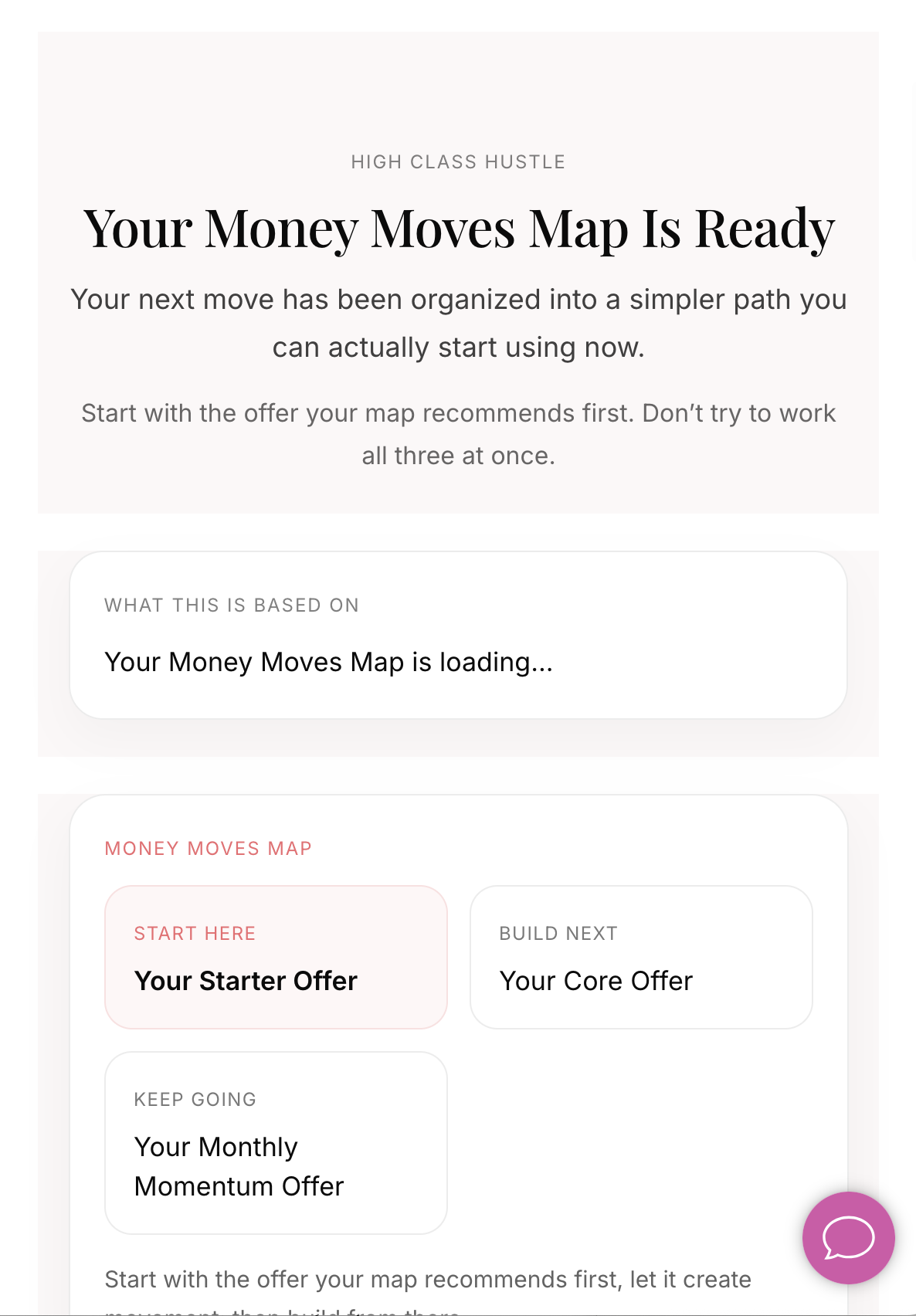
A look inside the Money Moves Map
The Map organizes the recommended starting offer, the offer to build next, and the continuity offer that can help create momentum over time.
You do not need the perfect answer before you begin
You need enough evidence to make a proportionate next decision.
That decision might be to speak with three people who have asked for similar help.
It might be to revise an existing offer rather than create a new one.
It might be to test a small service before building a full program.
It might be to pause a visually polished idea that still lacks a useful result.
It might be to document work you have already completed so the next buyer can see what the promise looks like in practice.
Focus does not require ignoring every other possibility forever.
It requires choosing which possibility has earned the next step.
Sort what is already asking for your attention
Use the free Money Moves Map to compare the questions, skills, evidence, audience needs, and delivery realities already present in your work.
Build Your Free Money Moves Map One resource. One next decision. No need to build everything today.Questions people ask when deciding what to sell
What should I sell if I have several skills?
Start with the intersection of a repeated need, a result you can explain, evidence that you can help, and a delivery method you can support. Having many skills does not require turning all of them into offers at once.
Should I build a website before I finalize my offer?
A simple web presence may be useful, but the offer should be clear enough to explain who it serves, what it solves, what is included, what it costs, and what the buyer should do next. A larger website cannot resolve an offer that remains undefined.
How do I know whether people will pay for an idea?
Repeated questions and interest are useful signals, but payment behavior must be tested. Use a clear conversation, pilot, small paid service, preorder, or another proportionate test before investing in the complete offer environment.
Does every repeated question need to become an offer?
No. Some questions belong in an FAQ, guide, referral, or existing service. A repeated question becomes a stronger offer candidate when the need is meaningful, the result is valuable, the work fits your capabilities, and the delivery can be sustained.
What is the Money Moves Map?
The Money Moves Map is a free Pink Swann resource that helps organize possible opportunities using repeated questions, audience needs, existing skills, useful evidence, delivery capacity, and the next responsible test.