
Where Does the Yes Go?
Your name can travel farther than your offer. If somebody praises, refers or follows your business but still doesn't buy, the problem may not be visibility. It may be what happens after interest arrives.
Somebody can know you're good, send your name into the room, and still have no clue what to pay you for. That gap is easy to mistake for a visibility problem. Before you chase more attention, look at what happens after attention arrives.
Somebody tells you, “I'm always telling somebody about you.” “You're so good at this.” “We definitely need to work together.” “Send me your information.”
And the love can be completely real.
That's what makes this business problem so confusing.
You aren't invisible. Your work gets compliments. Your posts get engagement. Somebody refers you. Your name comes up in rooms you aren't standing in. Maybe somebody lands on your website, follows your page or asks a few questions.
But the money stays strangely quiet.
That's usually when the diagnosis turns into reach: maybe I need more followers, maybe I need to post more, maybe I need another platform, maybe I need to run ads.
Sometimes, yes.
But before I send more attention toward a business, I want to know something else:
Because getting attention and turning that attention into movement are two different business problems.
You May Not Have a Visibility Problem
Some businesses genuinely need more discovery.
Then there are businesses already getting signs of interest: referrals, profile visits, comments, shares, inquiries, compliments, “send me your information,” and “I need to work with you.”
Those signals don't prove demand by themselves. But they do give us a reason to investigate what happens after somebody becomes interested.
Can somebody who already believes you're good at what you do figure out what to hire you for?
Can that person recognize which problem you solve? Tell which offer fits? Understand what happens first? Take action without needing you to personally explain every piece?
That's where visibility turns into something more useful:
movement.
And being valuable is not automatically the same thing as being easy to buy from.
What Is Customer Journey Friction?
Customer journey friction is anything that makes it unnecessarily difficult for an interested buyer to understand, choose or take the next step with your business.
Sometimes the friction is obvious.
The link doesn't work. Checkout is confusing. The service page doesn't explain the service.
But some of the most expensive friction looks completely normal to the person who built the business.
You know what everything means. Your customer doesn't.
You know which three services are basically variations of the same thing. Your customer doesn't.
You know a DM is supposed to happen before booking. The person on the page doesn't.
You know which Instagram post from three weeks ago explains the process.
They definitely don't.
Signs the buying path may be asking too much
- Interested clients repeatedly ask what you actually offer.
- Every inquiry requires a custom explanation.
- Your work gets compliments, but “How do I pay you?” rarely follows.
- Referrals arrive without understanding what they were referred for.
- Prospective clients keep asking, “Which one do I need?”
- Your website has several possible starting points but no obvious first one.
- Somebody has been “meaning to” work with you for months.
- Your DMs are doing work the page itself could be helping with.
None of these automatically means the business is broken. They're clues. And clues are useful.
The Explanation Tax: When You Have to Personally Translate Every Sale
One clue I pay close attention to is how much explaining has to happen before somebody can move.
If almost every interested client requires a long DM, then a voice note, then three screenshots, then another explanation of which service fits, then a separate message about where to pay…
I want you to notice that.
Not because explaining your work is bad. Some of us do sophisticated work. Context matters.
The problem is when your presence becomes the only thing holding the buying path together.
At that point, your expertise is carrying work your business setup should be helping carry.
I call that the explanation tax.
“I like this. Now what?”
The interest is warm, but the path keeps asking for another decision, another search or another explanation.
One more explanation.
You pay that tax in time.
You pay it in capacity.
You pay it every time an inquiry sits unanswered because you're working, parenting, serving a client, sleeping— or simply living your actual life.
The prospective customer can pay it too.
They have to keep remembering. Keep asking. Keep searching. Keep deciding whether they understand enough to proceed.
And buyers have lives.
They close tabs. They forget which post explained the thing. They tell themselves they'll come back.
If that pattern feels familiar, I've written more about what happens when you're forced to explain the same thing over and over .
More Followers Won't Automatically Fix an Unclear Buying Path
This is why “I need more followers” can become an expensive diagnosis.
Imagine 500 more potential clients discover the business tomorrow.
Great.
But what happens when they arrive?
If they encounter the exact same unclear offer, vague next step or confusing customer journey, you haven't necessarily created 500 new buyers.
You may have created 500 more spectators.
That's why I separate three questions:
Did they find you?
This is the attention question. If the right people are not discovering the business at all, you may genuinely need more reach.
Do they understand why it matters to them?
This is the meaning question. The right person should be able to recognize where they fit and why the work is relevant. If this is where things feel foggy, start with your position .
Once they're interested, do they know what to do?
This is the action question. Interest needs a starting point that doesn't require the buyer to understand your entire business first.
Those questions work together.
Traffic without clarity can amplify confusion. Clarity without traffic can leave a strong offer undiscovered. Attention without a next move can create a business that looks busy from the outside while revenue tells a very different story.
Try the 60-Second Hush Test
Open your website, Instagram profile, Facebook page or main business landing page.
But don't look at it like the founder.
Pretend you've never met yourself.
You get 60 seconds.
Can I understand enough to move?
Four questions. One minute. No founder context allowed.
1 What do you actually sell?
Not your résumé. Not every capability. What can somebody actually choose?
2 Who is it for?
Can the right client recognize themselves without reverse-engineering your language?
3 Why should I trust you?
Can I see relevant experience, process, examples, proof, specificity or outcomes you can actually stand behind?
4 What do I do next?
Not six competing actions. What is the first useful move?
If you cannot answer those clearly, your prospective client may not be able to either.
Your Business Can Have Range Without Making the Buyer Solve a Puzzle
I believe in businesses with range because mine has range.
Pink Swann has beauty, business, media, commerce and community work under one larger ecosystem.
Range itself isn't the problem.
Unstructured range is.
A department store can sell hundreds of things because it still gives you departments, signs and doors.
A business with multiple skills, services or revenue streams needs the same kind of logic.
Somebody should not have to understand every layer of your expertise before they can take the first useful step with you.
That matters especially for multi-talented founders.
When you can do a lot, it is tempting to explain a lot.
But the buyer is not necessarily asking:
“What is the full extent of your capability?”
They may simply be asking:
“Is there something here that solves the problem I have right now?”
Give them enough clarity to answer that.
How to Make Your Business Easier to Buy From
Notice what somebody already associates with you.
What gets referred to you? What does somebody repeatedly ask you to help with? What do clients already trust you to solve?
Recognition already happening around your work is information. Pay attention to it.
Give that problem a clear first move.
The first move doesn't need to solve everything. It needs to make movement possible.
A diagnostic. A consultation. A clearly defined service. A useful resource. A starter product. A booking action.
Put the next move where the interest happens.
If somebody discovers you through an article, social post, referral or Google search, what happens next?
The path doesn't have to look identical everywhere. It does need to make sense.
Reduce unnecessary explaining.
Listen to the questions you answer over and over.
Some belong in conversation. Others are telling you the business needs clearer language, structure, FAQs or service descriptions.
Watch what somebody actually does.
Compliments matter. Shares matter. Traffic matters.
But they answer different questions than: Did they click? Start? Finish? Inquire? Book? Buy? Take the next meaningful step?
Before You Build Something New, Map What You Already Have
This is where a lot of smart, multi-talented founders lose unnecessary time.
Something feels quiet, so we create.
Another product. Another service. Another PDF. Another landing page. Another platform. Another idea.
But sometimes the next money move isn't hiding inside something new.
It is sitting inside work you're already doing.
A skill somebody already asks you for.
A problem you already know how to solve.
A repeated request you've been treating casually.
A service that needs clearer packaging.
An existing offer that needs a better path.
That's exactly why I created the Money Moves Map™.
It helps you look at what you already know, do and have— and identify practical ways that value could become a clearer commercial move.
You do not need to walk into it with a perfect business model.
You need somewhere useful to start.
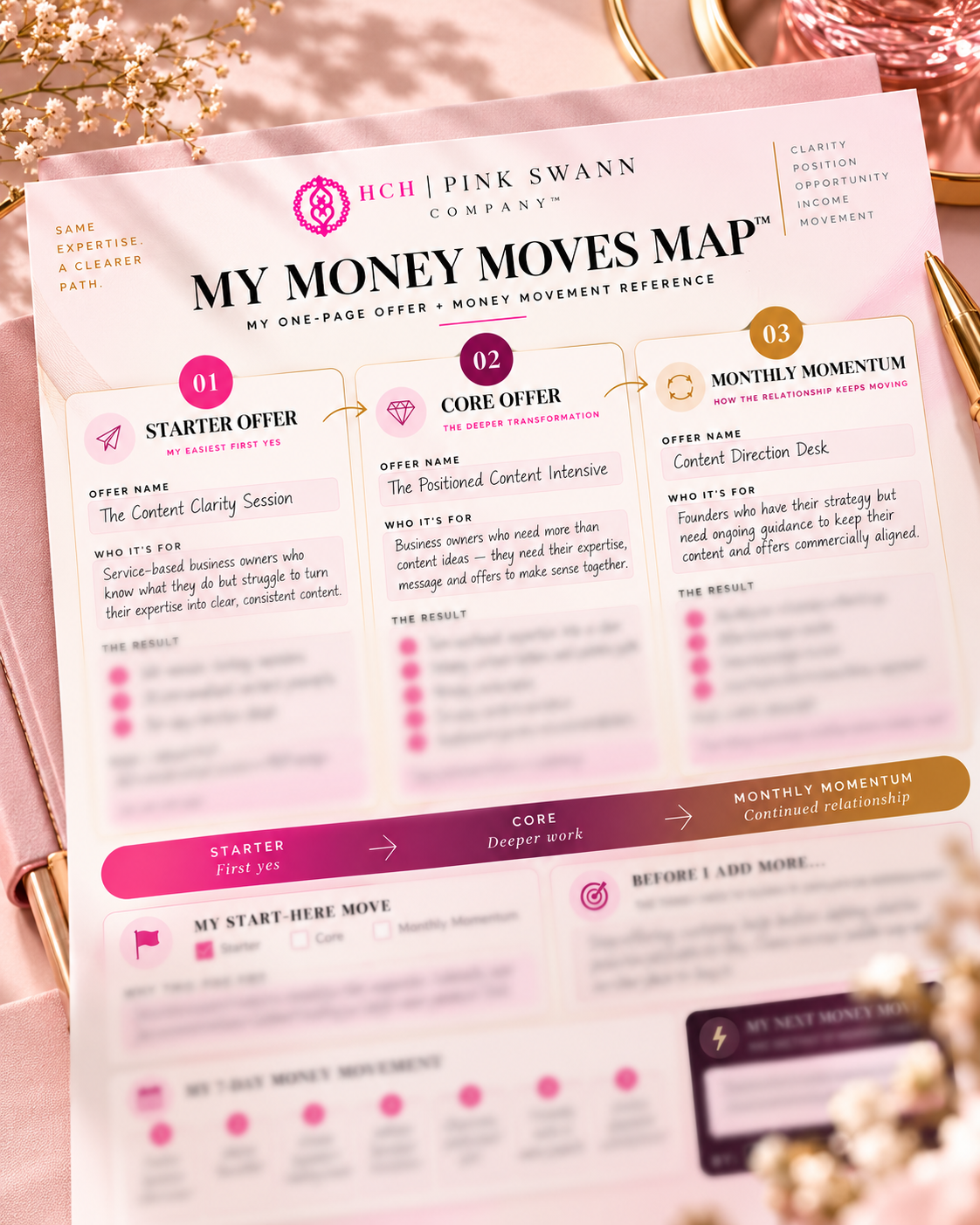
Find the money move hiding in what you already do.
Bring the skills, knowledge, repeated requests and opportunities already in your hands. The Money Moves Map™ helps you organize them into clearer possibilities worth examining next.
If Somebody Likes Your Business but Isn't Buying, Start With the Path
There is a difference between:
Nobody sees me.
and
Somebody sees me, but the movement keeps breaking somewhere.
Those problems should not automatically receive the same prescription.
Sometimes you need more reach.
Sometimes you need a stronger offer.
Sometimes you need more proof.
Sometimes the buying path itself is doing too much asking and not enough helping.
Your job is not to make every visitor buy.
It is to make it easier for the right person to recognize what is for them and take the appropriate next step.
Your expertise can be sophisticated.
Your business can have range.
Your work can keep evolving.
But the first decision should not require somebody to understand your entire universe.
Your presence should deepen the experience.
It should not have to rescue the explanation every single time.
If that answer still gets fuzzy, start by mapping what you already have.

About Sarah Swann
Sarah Swann is the founder of Pink Swann Company™. Her work spans business, owned media, professional presence and community leadership, with a focus on helping useful work become easier to understand, act on and sustain.